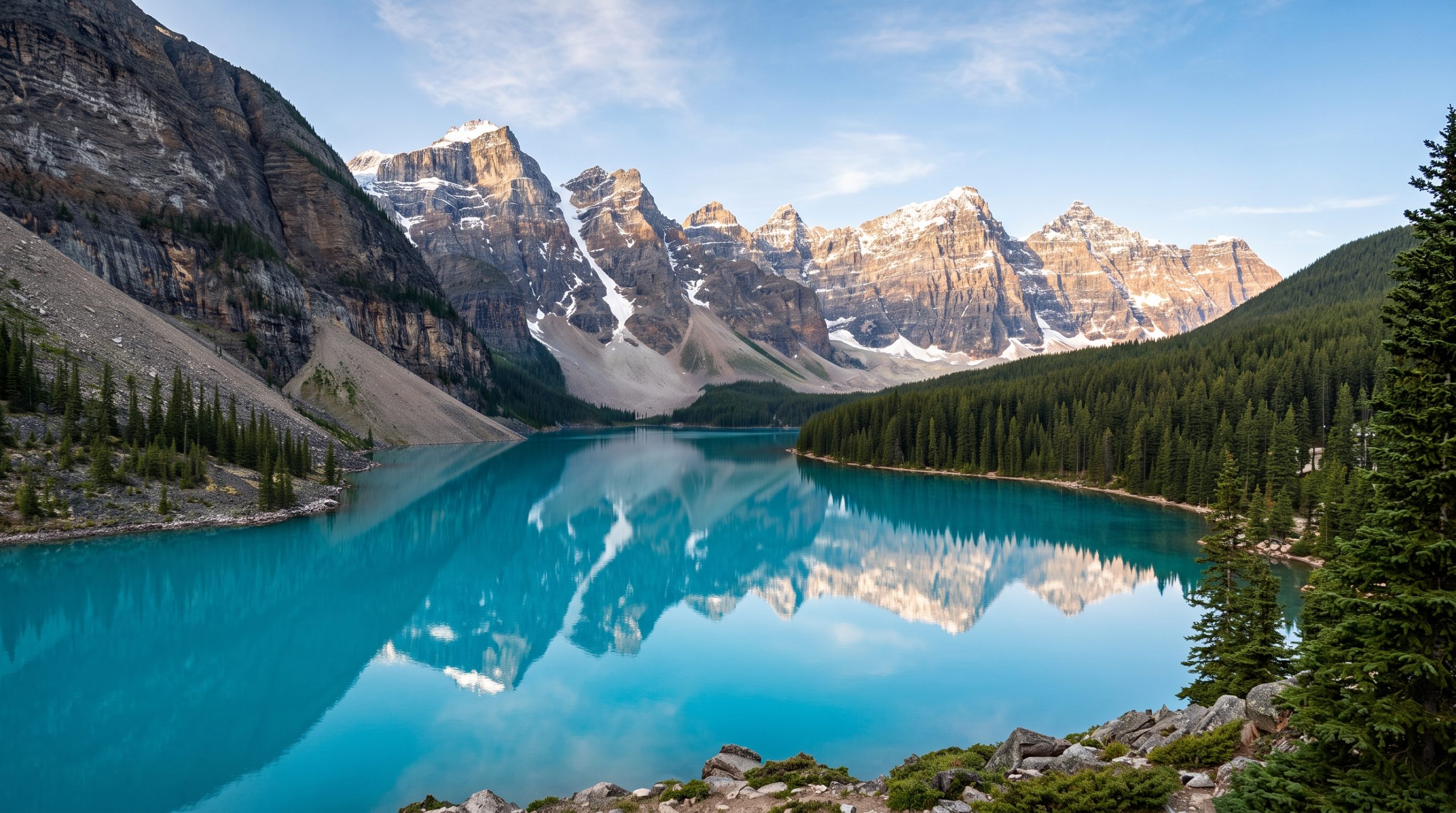
In mid-June the sun officially rises over Banff at about 5:25 in the morning. That is not when the light arrives. The Bow Valley is walled in on both sides, so the first real colour lands high on the face of Mount Rundle while the shoreline you are standing on stays blue and cold for another twenty minutes. Work to the printed sunrise time and you miss the best part of the morning.
The second thing Banff does to a plan is control the roads. Moraine Lake Road is closed to private vehicles, so the only way up is a reserved shuttle seat, a commercial bus or a licensed tour, and the road is seasonal: in 2028 it runs from June 1 to October 12, weather permitting. Parks Canada also sets the terms of the ceremony itself. A maximum of 20 participants. No tents or temporary shelters. Props kept small, at most an arch, a table and a chair. Quiet music only, the kind a guitar or a flute makes. And no exclusive use of anywhere, because the park is a public place and areas cannot be reserved.
We plan around all of that before anyone starts naming lakes. We are Unmapped Stories, eight people, four photographers and four filmmakers, running photography, film and planning as one service rather than three purchases. Our planning calendar for Banff currently covers 2027, 2028 and 2029 in the Rockies now.
Photo, film and planning in the Bow Valley, from one team
We photograph, film and plan Banff elopements as a single service. One full day of coverage starts at $4,900, and every experience includes location design, a timeline built around real light and real travel time, permit research and weather alternatives. Team travel to Alberta is included. Highlights reach you in five days.
A June day, timed to when the sun clears the ridgeline
This is a real June shape, built around Moraine Lake and the Lake Louise end of the park. We rebuild it for your date, because sunrise moves by roughly a minute a day and the shuttle season moves the whole plan in and out of reach.
- 3:40 am. We meet you where you are staying, in Banff town or up at Lake Louise. Hair and layers, no rush. At nearly 1,900 metres the pre-dawn air is genuinely cold in June, and the dress goes on under a down jacket that comes off at the last second.
- 4:20 am. Checked in for a sunrise departure up Moraine Lake Road. Parks Canada runs sunrise shuttles and licensed operators run their own, and seats are reserved well ahead rather than bought on the morning.
- 4:40 am. Civil dawn. Nothing at water level is lit yet, but the Wenkchemna wall opposite is already changing. Our photographer works the wide from the rockpile while our filmmaker sits on a long lens, holding the peaks and letting you walk into a frame that is mostly mountain.
- 5:25 am. Sunrise on paper. In practice, the light drops down the faces in a slow line, and for about fifteen minutes you can put yourselves exactly where it lands.
- 6:15 am. Vows, on ground we picked in the proposal rather than on the morning. Small, quiet, with whatever you have written on paper in your hands.
- 7:45 am. Back down the road on a return seat, and breakfast in Lake Louise or Banff while the first buses are still arriving.
- 10:30 am to 4:00 pm. Off. This is the part most timelines get wrong here. Mid-June gives Banff more than sixteen hours of daylight, and nobody photographs well in hour fourteen. You sleep, we scout, and we send you a message if the cloud is doing something worth reacting to.
- 5:30 pm. Second location and a change of scale. Bow Lake up Highway 93 North for glacier water and wind, or the Vermilion Lakes side of town when we want Mount Rundle across still water without a shuttle in the plan.
- 8:45 pm. The long, low hour. Warm light on the peaks, cool light in the shadows, and the tour traffic already back in town.
- 10:00 pm. Sunset. We keep going through blue hour to about 10:45, when civil twilight closes out.
- 11:15 pm. Back at your door. In June that is a nineteen-hour day for us and a split day for you, which is exactly why we build the afternoon gap in.
September rearranges the whole thing. By the last week of the month sunrise is around 7:40 and sunset around 7:25 in the evening, which turns a punishing start into a civilised one, and the larches above Moraine Lake usually turn gold in that second half of September while the road is still open. If you want one date rather than one month, tell us which of those two days you would rather live.
| When | Sunrise and sunset, roughly | Moraine Lake Road | What the day is like |
|---|---|---|---|
| Mid-June | 5:25 am and 10:00 pm | Open from June 1 | Sixteen and a half hours of light, a pre-4:00 am start, snow still lying on the high ground |
| Mid-August | 6:30 am and 9:05 pm | Open | Warm evenings, the busiest weeks of the year, late-summer haze that softens the far peaks and rewards long lenses |
| Late September | 7:40 am and 7:25 pm | Open until October 12 in 2028 | Gold larch above the lake, cold still mornings, a start time you can live with |
| Late December | 8:45 am and 4:35 pm | Closed for the season | Eight hours of daylight that never climbs high, frozen lake surfaces, the town quiet at dawn |
The crowd question, and the two hours that answer it
This is what couples actually write to ask us about Banff, and it deserves a straight answer. Yes, the famous shorelines get busy, and no, you cannot hold one for yourself. Parks Canada is explicit that the park is a public place and that areas cannot be reserved, which is the right rule and also the one that decides your start time.
The Lake Louise lakefront at eleven in the morning in July is a flat, crowded place to photograph, and we will not build your ceremony there. Two things fix it. The first is the hour: between civil dawn and about 7:00 am, the same ground is close to empty and the light is the best it will be all day. The second is the shuttle system, which stacks arrivals into waves keyed to departures instead of a steady trickle, so there are real gaps and we know roughly when they fall. Add twenty-five minutes of walking away from any parking area and the number of people in your frames drops to almost none.
The rest is framing. Under a 3,000 metre wall you are a small figure in a very large picture, and strangers a hundred metres off read as scale rather than intrusion. Send us your date and we will tell you what the light does that morning and where we would stand: Tell Us Your Story.
Two cameras on a shoreline nobody can close
Banff is the destination where hiring a photographer and a videographer separately costs you the most. Start with the shuttle. Two vendors booked by two different people need two reserved seats on the same sunrise departure, two check-ins, and two sets of gear through the same door, and if one seat does not come through, half your coverage is standing in the Park and Ride at 4:20 am. Our photographer and filmmaker travel on the same reservation because we made it.
Then there is the aerial question. Drone flight is a restricted activity inside Banff National Park and recreational flying is not permitted, and the airspace over the town of Banff is restricted as well, partly because of the local heliports. So the film here is built entirely on the ground, and that changes what we do rather than diminishing it. Gimbal moves along the rockpile. Long-lens compression that stacks the Ten Peaks behind you. A camera that stays completely still for forty seconds while cloud crosses a face, because in this landscape stillness reads as scale. Where aerials genuinely matter to a couple, we plan that portion of the day outside the park boundary and confirm the permissions before it goes anywhere near the timeline.
Working as one unit also solves the physical problem of this place. The ground you want is narrow: a rockpile, a lake edge, a strip of shoreline forty metres wide with other people on it. One photographer and one filmmaker who have worked together for years split that space on purpose. One holds the wide and stays put. The other moves, low and long, and neither ends up in the other’s frame. Two strangers meeting at 4am negotiate the same forty metres in whispers while your light burns off.
And when the weather turns, which it does, one team makes one decision. On The Expedition the filmmaker is already recording vow audio at the sheltered spot while the photographer holds the ridge for the two minutes the cloud lifts. You can see how that comes out in our published films and galleries, which is a more useful thing to look at than any promise we could make in a paragraph.
What sits inside a Banff experience, and where coverage starts
Every experience, whichever one you choose, includes all of this:
- Destination and location design for your date, not a list of the same four lakes
- Planning throughout, and a custom timeline built around light and real travel time
- Permit research and logistics guidance, including the Parks Canada ceremony registration and the shuttle access that goes with it
- Weather alternatives and backup planning, with a second location held for every hour of the day
- Drone footage where it is legal, safe and appropriate, which in this park means outside the boundary or not at all
- Highlights delivered in 5 days, and the full gallery or film in 3 weeks
- Team travel worldwide, so flights, accommodation and ordinary travel for the assigned team are already inside the figure
The Adventure is one full day with one dedicated photographer or one dedicated filmmaker, at the figure named further up this page. The Expedition is $7,900 and puts a dedicated photographer and a dedicated filmmaker on the same day, working together, and adds professional audio for vows where conditions allow. The Odyssey runs two to seven days across one or several destinations, photography and film, with a custom proposal, and it is the one couples pick when Banff is joined to Yoho, the Icefields Parkway or Kananaskis rather than squeezed into a single sunrise. Full detail sits on our pricing page. Guest count does not change what you pay us; it changes access, permits, transport and timeline.
What Banff adds on top, paid by you directly: the Alberta marriage licence, which carries a government fee of forty Canadian dollars plus whatever the registry agent charges for issuing it; a valid park entry pass for every person attending, which Parks Canada requires; a reserved shuttle seat per person if the ceremony is up Moraine Lake Road; your officiant or marriage commissioner; accommodation; and any unusual transport such as a helicopter out of Canmore or a 4×4 charter. Those are the only Banff costs that sit outside what we quote.
How a Banff enquiry becomes a held date
- You send the inquiry form with your date, or the month you are circling.
- We reply within 24 hours with our initial brochure and a first read on what your date makes possible.
- We build a tailored proposal around the day you actually want.
- You sign the contract and pay a 30% retainer.
- Planning begins, and location design, timeline and permit research start moving.
- The rest of the payment plan is set out in the proposal, so there is nothing to guess at.
If you are earlier than that and still deciding what shape the day should take, our planning fundamentals cover the parts that apply anywhere.
Who Banff suits, and which month suits which couple
Banff rewards couples who are willing to be awake before four in the morning in summer, who are steady on uneven ground, and who can hear “the cloud has dropped, we are going to the other lake” at 5am without it ruining anything. The rockpile at Moraine is a short scramble over loose boulders in the dark. The best light of the year arrives at an hour most people are asleep.
If a 3:40 am start is honestly not who you are, that is worth saying in your first message, because the fix is a month rather than a compromise. Late September hands you a 7:40 sunrise and gold larch on the same ground. If uneven footing is the issue, we build the day on the valley floor instead, where the Vermilion Lakes boardwalks and the Bow Valley lake edges give you Rundle and still water without a scramble. If you want more than one landscape, that is what the multi-day option exists for. Our destination guides are a good place to compare Banff against the other mountain regions we work in before you commit to one.
Tell us what you actually want out of the day and we will shape it around you, or tell you honestly which month or which corner of the park fits it better.
Common questions
Do we need a permit to get married in Banff National Park?
You file a wedding ceremony registration with Parks Canada, which sets the conditions rather than reserving you a spot. The main ones: a maximum of 20 participants, everyone holding a valid park entry pass, no tents or temporary shelters, small props only, quiet music, and a full clean-up straight after. Preparing that paperwork with you is part of our planning.
Can we still get married at Moraine Lake now the road is closed to cars?
Yes, and it changes only how you arrive. Moraine Lake Road is closed to private vehicles, so access is by reserved shuttle, commercial bus or licensed tour, and the road is open seasonally, June 1 to October 12 in 2028. Sunrise departures exist and they sell out well ahead, which is why your shuttle seats get booked at the same time as the timeline is written.
Can you fly a drone for our Banff elopement film?
Not inside the park. Drone flight is a restricted activity in Banff National Park and recreational flying is not permitted, and the airspace over the town is restricted too. We build the film from the ground here, with gimbal movement and long-lens work that uses the scale of the peaks. Where aerials matter to you, we plan that part of the trip outside the park boundary and confirm permissions first.
How do two Americans get an Alberta marriage licence?
There is no residency or citizenship requirement in Alberta. Both of you appear in person together at a registry agent with valid ID, and the licence is issued on the spot for a government fee of forty Canadian dollars plus the agent’s own service charge. You also need two adult witnesses, and your officiant files the paperwork afterwards. We build the registry stop into the days before your date.
Is June or September the better month for a Banff elopement?
June gives you the most light and the widest access, with sunrise near 5:25 and sunset near 10:00 pm, and it asks for a start time before four. Late September gives you a 7:40 sunrise, gold larch, cold still mornings and a road that stays open into October. Same landscape, two completely different days.
What happens if it snows on our date in September?
We plan for it, because snow above 2,000 metres in September is normal rather than exceptional. Every hour in your timeline has a second location held against it, usually fifteen to thirty minutes away and lower down, and we check road status, trail advisories and the forecast the week before and again that morning. Fresh snow on gold larch is one of the best things that can happen to your film.
Do you charge travel to come to Banff?
No. Team travel is included worldwide, so flights, accommodation and ordinary travel for the assigned photographer and filmmaker sit inside the figure we quote, with no long-haul surcharge and no European or long-haul distinction. What you pay separately in Banff are the licence, park passes, shuttle seats, your officiant, your own accommodation and any unusual transport.
How long until we see the photos and the film?
Highlights land in 5 days, while you are still somewhere in the mountains or on the flight home. The full gallery or film follows within 3 weeks.
Booking a Banff date, in writing
We keep the planning in one written thread. You send a message, we reply within 24 hours with the brochure and a first read on your date, and the whole plan is built through email and shared documents you can read at your own pace, in your own time zone. If you have a date in mind for 2027, 2028 or 2029, or two dates you are weighing against each other, Check Your Date and we will tell you exactly what that morning in the Bow Valley can be.