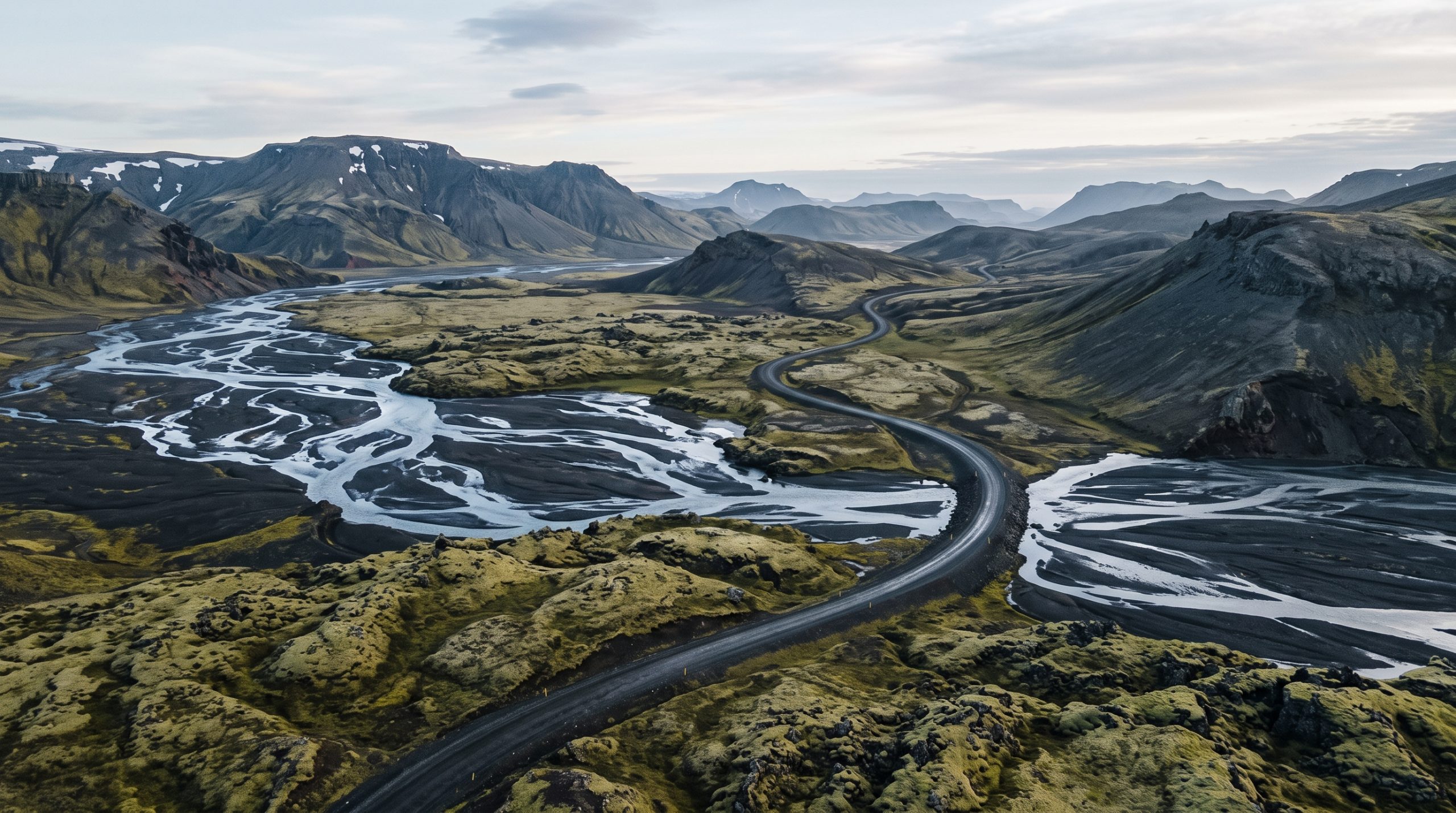
Around the June solstice the sun comes up over Reykjavik just before three in the morning and does not set until after midnight. Six months later it clears the horizon close to 11:20am and is gone again by about half past three. Almost every planning decision bends around those two numbers: when the ceremony happens, how far you can drive in a day, and whether you sleep before the vows or after them.
The legal side is smaller than most couples expect. Civil ceremonies in Iceland are performed by district commissioners and their legally trained representatives, and the document that clears the way is an examination certificate from that office, issued once your marital status paperwork checks out. The fee for issuing it is currently 6,700 ISK, sent by bank transfer.
The rest is roads, wind and daylight. What follows is the operational version of an Iceland elopement, written the way we plan one.
Keflavik, one certificate, and three days on the ground
Fly into Keflavik, allow around 45 minutes to reach Reykjavik, and hold three days minimum: one to land and settle logistics, one for the ceremony, one kept in reserve for weather. Your marriage runs through a district commissioner, whose examination certificate currently costs 6,700 ISK. Everything else is driving distance and daylight.
The paperwork, and who actually signs it
Iceland routes marriage through the syslumadur, the district commissioner, rather than a town hall or a church. Civil ceremonies are performed by commissioners and their legally trained representatives, and the whole file sits with that office.
What the commissioner needs from two Americans is a certificate of marital status issued by the relevant authority at home. If your country does not issue one, you supply certified confirmation of that fact, and both of you make a formal declaration about your marital status instead. Anyone married before adds the divorce documentation. Once the file is clean, the commissioner issues a certificate of no impediment and certifies it on the Marriage Notification form.
The fee for issuing the examination certificate is currently 6,700 ISK, transferred to the account of the District Commissioner of Westman Islands, and Iceland states plainly that bank and service charges for foreign transfers are added on top. Send it as one payment and keep the confirmation. There is an electronic application route, and a form-and-email route for couples who cannot use it.
After the ceremony the marriage is notified to Registers Iceland and enters the National Registry, which is what makes the certificate you carry home a real one. Where a site or landowner charges a permit fee, that fee is yours; working out which locations need what, and guiding the applications, is ours. If you are still at the stage of sorting the order of operations, our walkthrough of how eloping actually works covers the sequence from first idea to signed certificate.
Twenty-one hours of daylight, then four
On June 21 in Reykjavik the sun rises at 2:55am and sets at 12:03am, and for roughly three hours in between it sits just below the horizon and keeps the sky lit. There is no golden hour in the sense you are used to, but a long golden evening from about eight until nearly midnight, and a second one starting again around three.
Around the winter solstice the same city gets the sun up close to 11:20am and down around 3:30pm. Four or five usable hours, all of them low and soft. Not a worse day to be photographed, just a completely different one to schedule, with the ceremony at noon rather than ten at night.
Iceland stays on GMT all year and never changes its clocks, so nothing in your planning notes shifts under you in March or October.
| When | Daylight in Reykjavik | Where the ceremony hour lands |
|---|---|---|
| Late May to mid-July | Close to 21 hours, twilight instead of night | 9pm to midnight, or a 3am start on empty roads |
| August | Shortening quickly, real darkness by month end | Evening, with aurora possible again late in the month |
| September to October | Around twelve hours at the equinox, falling fast | Late afternoon, first snow on the high ground |
| November to January | Four to five usable hours at the solstice | Midday, with everything else built tight around it |
| February to April | Climbing back toward twelve hours | Mid to late afternoon, highlands still shut |
Summer twilight is the reason a film shot here at eleven at night looks nothing like a film shot at eleven at night anywhere else. That is easier to see than to describe, so spend ten minutes in the galleries and films we publish before you commit to a month.
Wind, and what it does to a dress at 6am
Couples prepare for cold and get caught by wind. A dress with weight in the hem behaves out there; unlined chiffon becomes a flag and stays one. Wool base layers go under everything and nobody ever sees them. Bring boots you have already walked in, a second pair for the car, and a coat you can shed in ten seconds without a mirror. Vow books need a clip or an elastic band, because loose paper leaves. For the ceremony hour we pick the lee of something solid, a bluff or a lava wall, and we tell you which way to face before you are standing there deciding.
Where the map lies on Route 1
Route planners are honest about Iceland’s distances and misleading about its days. These are the numbers we schedule against.
| Route | Planner estimate | Plan on | Why the gap |
|---|---|---|---|
| Keflavik to central Reykjavik | About 45 minutes | Around 75 minutes from wheels down | Rental desk, fuel, supermarket |
| Reykjavik to Vik | Roughly 2 hours 20 | 2.5 to 3 hours | Wind on open stretches, and you will stop |
| Keflavik to Vik with south coast stops | 3 hours nonstop | 8 to 10 hours | Waterfalls, beaches, parking queues |
| Reykjavik to Jokulsarlon | Around 4 hours 30 | 4.5 to 5 hours each way | Not a same-day return in any season |
| Reykjavik to Grundarfjordur, Snaefellsnes | About 2 hours | 2 to 2.5 hours | Peninsula roads slow in wind |
| Reykjavik to Akureyri | About 5 hours | 5 to 6 hours on Route 1 | Weather dependent from October |
| Full Ring Road, about 1,300 km | Roughly 15 hours driving | 7 to 10 days | The stops are the reason you came |
Most of the big south coast stops now charge for parking. At Skogafoss and Seljalandsfoss it is currently around 1,000 ISK for a standard car, paid by app or kiosk, and at recent rates that is a little under eight US dollars. Assume two or three of those in a full day and carry a card that works contactless.
The highlands run on a separate calendar. Most F-roads open between mid-June and early July, and Vegagerdin, the road administration, sets each opening after physically inspecting that road rather than by a date on a chart; road.is publishes the live state of every one. They are 4×4 only, and rental agreements say so in writing. If your date is in May and your heart is set on the interior, we build a low-ground day and put the interior in a proposal for another month. Tell us which matters more, the date or the terrain, and we will tell you honestly which weeks give you both.
One thing we would talk you out of: Jokulsarlon as a day return from Reykjavik. It is four and a half to five hours each way. In June you can make it work and still lose ten hours to a windshield. In December you would drive both ends in darkness for a short window at the ice. Sleep within an hour of the lagoon instead and it becomes one of the best mornings in the country. Region by region, our destination guides go deeper on what each corner is actually like to work in.
Where to base yourselves
Reykjavik earns the first night and anything administrative, and it puts the Golden Circle and the Reykjanes lava fields within an easy morning. Everything east of Vik is a long day from there. Basing between Hella and Vik removes the first two hours from every south coast morning, which is the difference between a 4am alarm and a civilized one. Moving hotels nightly only pays off across more than one region, because packing at 7am costs you the light you flew here for.
Drones: three authorities, three different answers
Aerials here are governed by more than one office, and those offices do not defer to each other.
Samgongustofa, the Icelandic Transport Authority, sets the aviation baseline: registration for drones over 250 grams, a ceiling of 120 metres above ground level, and the aircraft in sight at all times.
The Environment Agency of Iceland handles the protected areas it manages and publishes a processing time of 15 days for general drone licence submissions. It also states that it does not grant drone permission inside Vatnajokull National Park or Thingvellir National Park. Those two are applied for directly.
Vatnajokull National Park, which covers Jokulsarlon and Skaftafell, allows recreational drone use in general while applying regional restrictions area by area, and issues no special recreational permits. Film and advertising licences are a separate track, charged against the park’s price list, and must be applied for at least 30 days in advance. Thingvellir sets a clock rather than a permit for personal flying: in the area running from Almannagja down to Thingvallavatn, drone flying happens before 9am or after 6pm. That rule costs us nothing, because we are standing on that ground at six in the morning anyway.
So we confirm the authority, the window and the lead time before designing any part of a film around an aerial, and we never build a film that falls apart if the wind says no. Drone footage is included wherever it is legal, safe and appropriate, and permit fees, where a site charges them, sit on your side of the ledger.
The buffers we build in before you ever see a timeline
Every Iceland timeline we write has slack in three specific places. The first is arrival day, which carries nothing at all. Transatlantic flights land in the morning, the rental queue is unpredictable, and a couple awake for eighteen hours photograph like a couple awake for eighteen hours.
The second sits on either side of the ceremony hour. We never set the vows against a hard edge, a fixed table booking or a drive that has to finish in daylight. The hour before belongs to the two of you and to the weather changing its mind.
The third is a reserve location for every primary one, usually within twenty minutes and facing a different direction, so a wind shift becomes a decision instead of a scramble. Location design, the timeline, permit research and weather alternatives come with every experience.
On a day with a dedicated photographer and filmmaker, we usually run two vehicles. One goes ahead to read the light and the parking at the next stop while the other stays with you, which on the south coast is the difference between reaching a waterfall in the middle of three coach loads and reaching it twenty minutes after they pull out. It also puts a second full set of bodies, lenses and batteries on the ground, which matters more here than most places, because the nearest replacement for anything is Reykjavik and Reykjavik might be five hours behind you.
One full day with a dedicated photographer or filmmaker starts at $4,900, and the day with a photographer and filmmaker working together starts at $7,900, with everything that includes, team travel worldwide among it, set out on our pricing page. Highlights reach you five days after the day itself, and the full gallery or film within three weeks.
If you already have a month in mind for 2027, Send Us a Message and we will tell you what that month does to your light, your roads and your paperwork before you book a single flight.
Common questions
How many days should we plan in Iceland for our elopement?
Three on the ground is the working minimum: arrival, ceremony, and one held back for weather. Five gives you a second region or a real reserve day. Anything including Jokulsarlon needs an extra night on that side of the country, since the lagoon sits four and a half to five hours from Reykjavik one way.
When do we start the Icelandic marriage paperwork, and who issues it?
Start as soon as the date is fixed. The district commissioner is the office that matters. You supply a certificate of marital status from the relevant authority at home, plus divorce documentation if either of you has been married before, and the commissioner issues the examination certificate for a fee currently set at 6,700 ISK, with foreign transfer charges on top. Registers Iceland records the marriage afterward.
Can we fly a drone at Thingvellir or inside Vatnajokull National Park?
Yes, within each park’s own rules. Thingvellir asks that drone flying between Almannagja and Thingvallavatn happens before 9am or after 6pm. Vatnajokull allows recreational use in general with regional restrictions and issues no special recreational permits, and film licences there must be applied for at least 30 days ahead. Other protected areas run through the Environment Agency and its 15 day processing time.
Do we need a 4×4, and can we reach the highlands in June?
For Route 1, the Golden Circle and the south coast in summer, a two-wheel-drive car is enough. The F-roads into the interior are 4×4 only and rental contracts enforce it. Most open between mid-June and early July, with Vegagerdin setting each date after inspecting the road, so an early June highland plan needs a low-ground plan behind it.
Is Jokulsarlon realistic as a day trip from Reykjavik?
Not in a way you would enjoy. It is four and a half to five hours each way, so a return trip spends around ten hours in the car, and in winter both ends of that drive are unlit. A night within an hour of the lagoon turns the same plan into a slow sunrise at the ice with the road to yourselves.
What time will our ceremony be in June compared with December?
In June, most likely between 9pm and midnight, since the sun rises at 2:55am and sets at 12:03am around the solstice and the low light runs for hours. In December it sits close to midday, with the sun up around 11:20am and down near 3:30pm, and everything else built tightly around that block.
What does parking cost at the big south coast waterfalls?
Skogafoss and Seljalandsfoss both charge for parking, currently around 1,000 ISK for a standard car, paid through an app or a kiosk on site. A full south coast day usually touches two or three paid car parks, and the machines expect a contactless card rather than cash.
Choosing the month before you choose the date
Pick the month first and the date second. The month decides your ceremony hour, whether the interior is open, how many hours of driving sit between two locations, and how much reserve the schedule needs. After that, a date is easy. We are booking 2027, 2028 and 2029, and everything between us happens in writing, at whatever hour suits you, starting with a reply and an initial brochure within 24 hours of your message. Tell us the landscape you keep coming back to and we will tell you which weeks of 2028 give it to you properly. Check Your Date